MASTEC × LYZR · AGENTIC TRANSFORMATION APPROACH

The next growth chapter demands compounding moats

The growth curve is steepening. Revenue guided to $17.5B in 2026 (+22% YoY), $22B by 2028, with EPS on track to more than double. The moats that built MasTec now need to compound faster than the business.

2025: $14.3B2026 guide: $17.5B2028 target: $22BBacklog: $20.3BBook-to-bill: 1.4x
Sources: MasTec Q1 2026 earnings call (1 May 2026); Investor Day (12 May 2026)
SECTION 02 · OPERATING MOATS

Five moats

[PRIORITIZED]
Cost
  • Competitive pricing intelligence at bid time, not after
  • Margin-guarded submissions across every segment
  • Per-segment cost baselines from historical bid data
[PRIORITIZED]
Predictability
  • Speed and execution certainty already differentiate MasTec
  • Customers moving to alliance and sole-sourced pursuits
  • Bid velocity determines shortlist position
[FOR DISCUSSION]
Control
  • Same capabilities across 5 segments and 810 locations
  • Turnkey delivery pulls civil, power, telecom, maintenance into one execution
  • M&A acceleration through 2026 needs an integration standard
[FOR DISCUSSION]
Future-Proofing Portfolio
  • Infrastructure built for customer AI adoption
  • Agent-ready delivery motion across segments
  • IP owned by MasTec — models, workflows, agents
[FOR DISCUSSION]
Scaling Talent
  • Senior expertise available across 810 locations
  • 35+ training centers, ~38,000 trained
  • Agents extend crews rather than replace them
SECTION 03 · PRIORITIZED USE CASE

RFP Intelligence.

[PRIORITIZED] · EXTENDING PREDICTABILITY
OBSERVED FROM DISCOVERY · HYPOTHESES TO VALIDATE NEXT ROUND
OPERATIONAL PAIN POINTS
  • Manual solicitation review — RFPs of 500 to 2,000 pages are read section by section, yet requirements surface late
  • Bid knowledge locked in individuals — the estimator who won the last one holds the playbook
  • Alliance and sole-sourced pursuits blur the process — different rhythm, same team, no distinction
SOLUTION WORKFLOW
STAGE 01
Ingest
RFP of 500 to 2,000 pages plus attachments received
STAGE 02
Extract
Compliance requirements, key dates, evaluation criteria parsed
STAGE 03
Leverage
Historical win/loss retrieval, past-performance evidence surfaced
STAGE 04
Draft
Response sections, executive summary, pricing envelope assembled
STAGE 05
Review
Bid team validates, edits, approves for submission
AGENT STAGES IN CORAL · HUMAN TOUCHPOINT IN INK
Illustrative UI
PRIORITIZED USE CASE · EXTENDING PREDICTABILITY · MASTEC × LYZR
SECTION 04 · PRIORITIZED USE CASE

Competitive Pricing Intelligence.

[PRIORITIZED] · EXTENDING COST
OBSERVED FROM DISCOVERY · HYPOTHESES TO VALIDATE NEXT ROUND
OPERATIONAL PAIN POINTS
  • Pricing from memory, not data — estimators reprice past wins, not current signals
  • Manufacturer benchmarking too late — gathered during bid crunch, not upfront
  • Cost-efficiency opportunities surface only in the loss debrief
SOLUTION WORKFLOW
STAGE 01
Ingest
Solicitation requirements, geography, scope of work received
STAGE 02
Research
Manufacturer benchmarks, competitor pricing, geographic cost data pulled
STAGE 03
Analyze
Cost-efficiency opportunities and competitive positioning identified
STAGE 04
Recommend
Pricing envelope drafted with confidence tiers
STAGE 05
Review
Estimator validates, adjusts, finalizes for submission
AGENT STAGES IN CORAL · HUMAN TOUCHPOINT IN INK
Illustrative UI
PRIORITIZED USE CASE · EXTENDING COST · MASTEC × LYZR
SECTION 05 · ARCHITECTURE

A layer above the existing stack, not another tool inside it.

DIFFERENTIATOR 01

Advanced memory management

Lyzr's memory architecture is what other platforms underbuild. MasTec's workflows are stateful — bid pursuits, project handoffs, field-ops investigations all need persistent context across agents and time.

DIFFERENTIATOR 02

Cross-framework orchestration

The workbench orchestrates agents whether they're built on Lyzr, LangChain, Crew, or Agentforce. Existing Agentforce experiments and Bedrock work don't get scrapped — they get registered, governed, and conducted through one plane.

DIFFERENTIATOR 03

Open posture, no lock-in

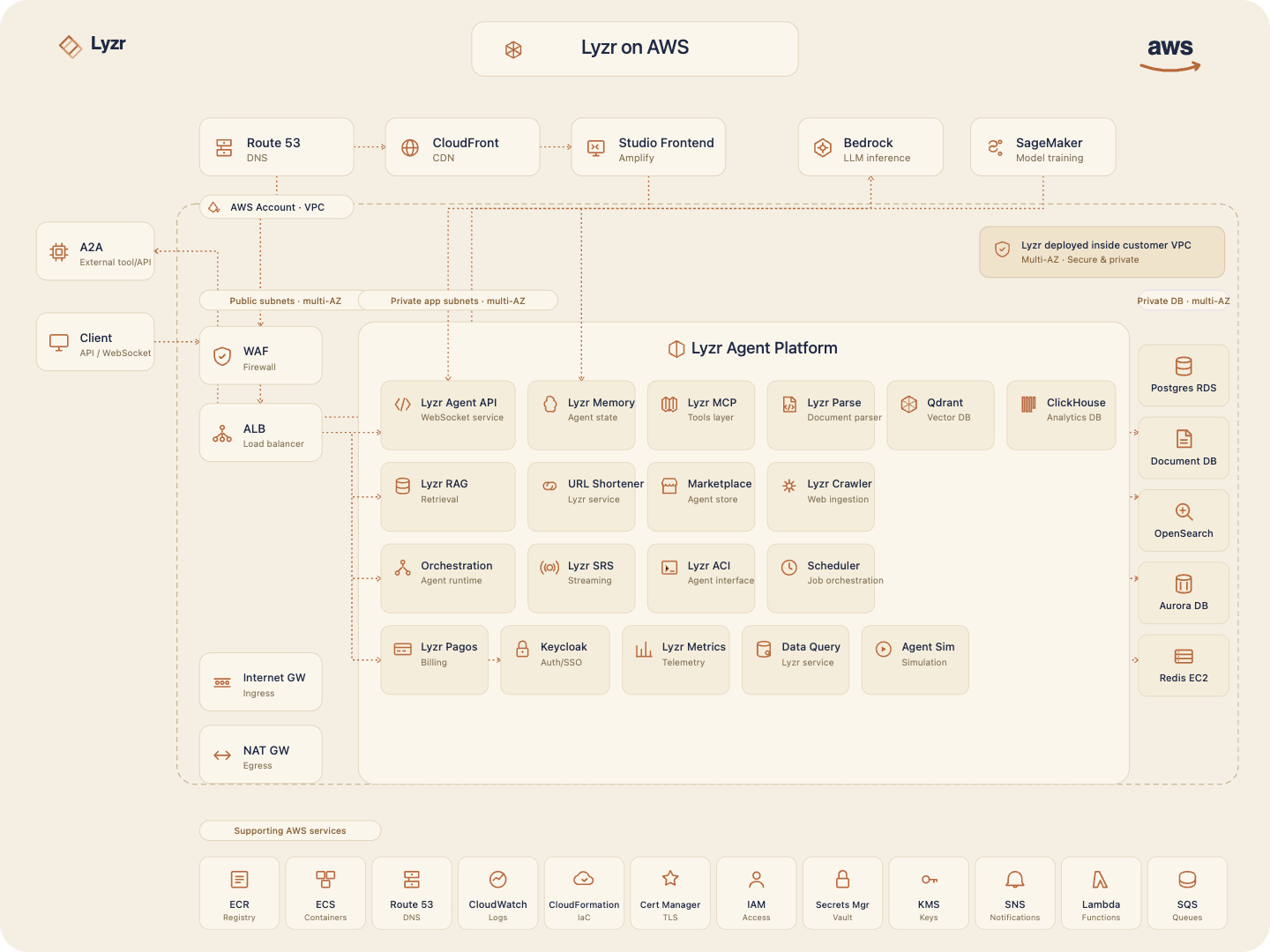
Lyzr is open-source-first. Git Agent and Open GAP make every Lyzr-built agent portable. The platform deploys inside MasTec's AWS VPC — your data never leaves; your agents are yours.

Lyzr Enterprise Studio · production deployment topology
REFERENCE ARCHITECTURE
Lyzr Enterprise Studio production deployment topology on AWS
LYZR ENTERPRISE STUDIO · DEPLOYED INSIDE MASTEC AWS VPC
SECTION 09 · COMMERCIAL

Pricing & Business Case

RFP INTELLIGENCE · PRELIMINARY ESTIMATES · ASSUMPTIONS TO VALIDATE
$9.2M
NET ANNUAL SAVINGS
After platform and LLM costs
25x
RETURN ON PLATFORM COST
$386K total annual cost
$3,126
PER-RFP SAVINGS
Across ~2,940 annual solicitations
FINANCIAL MODEL · RFP INTELLIGENCE
Revenue context
Revenue, TTM$15.3B
Bid-based revenue (est. 50%)$7.7B
RFP funnel
Solicitations screened (annual)2,942
Pursue rate at Go/No-Go65%
Bids submitted (annual)1,913
Win rate25%
Deal wins (annual)478
Labor cost — tiered
Screening labor ($4K × 2,942 solicitations)$11.8M
Bid response labor ($27.3K × 1,913 bids)$52.1M
Total RFP labor cost$63.9M
Agent-led savings
Effort reduction (conservative)15%
Gross savings$9.6M
Platform cost
LLM cost (annual)$136K
Lyzr platform cost (annual)$250K
Total platform cost$386K
Net position
Net savings (annual)$9.2M
ROI25x
Tiered labor: Small/Mid bids $18K (75% of volume) · Large/Complex bids $55K (25%) · Blended $27.3K
15% effort reduction is conservative — industry benchmarks for AI-assisted document processing: 20%–40%
SENSITIVITY ANALYSIS · NET SAVINGS ($M)
10% reduction15% reduction20% reduction25% reduction
40% bid-based$4.7$7.3$9.8$12.4
50% bid-based$6.0$9.2$12.4$15.6
60% bid-based$7.3$11.1$14.9$18.8
Highlighted cell = base case · Revenue base, deal size, win rate, pursue rate, and platform cost held constant
KEY TAKEAWAYS
ROI survives aggressive downside assumptions
Even at 40% bid-based revenue and only 10% effort reduction, net savings exceed $4.7M — a 12x return on platform cost. The business case does not depend on optimistic assumptions.
Cost savings are the floor, not the ceiling
This model captures labor cost reduction only. The compounding value — faster bid cycles, higher win rates, institutional knowledge retained across bids — is not quantified here and compounds over time.
Every assumption is testable in a pilot
Bid-based revenue share, labor cost per RFP, and effort reduction percentage can all be measured against actual MasTec data during a scoped pilot. The model is designed to be validated, not believed.
COMMERCIAL STRUCTURE · POST-DISCOVERY

Licensing, deployment model, and commercial terms to be developed following scope confirmation and pilot design.